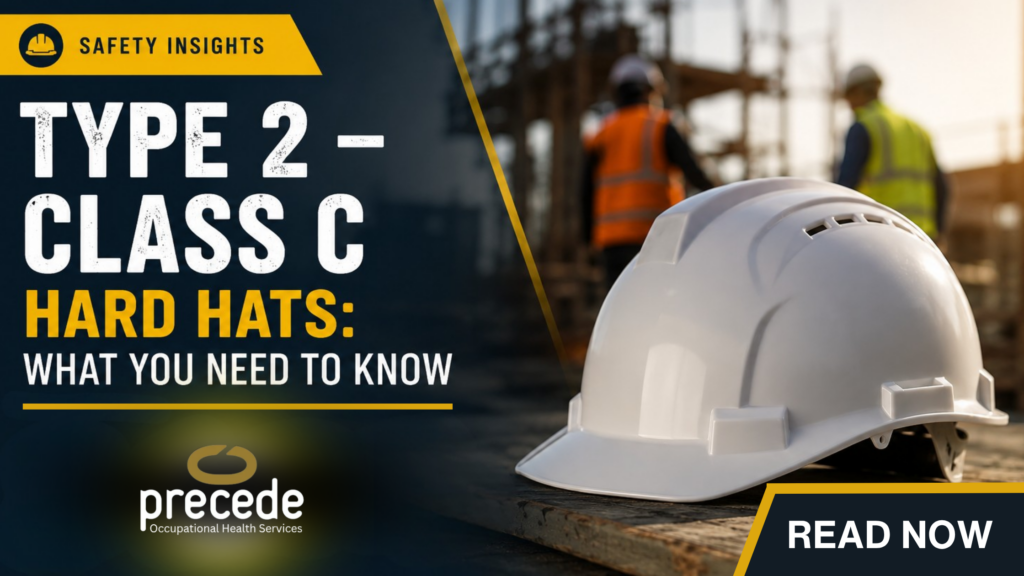
Hard hats are a critical part of workplace safety, helping protect workers from serious head injuries caused by falling objects, impacts, and other site hazards.
However, workplace safety standards and protective equipment are continuing to evolve, many employers are considering a move from traditional Type 1 hard hats to Type 2 hard hats, which are designed to provide additional protection against impacts from multiple directions.
But what exactly are Type 2 – Class C hard hats, and could they be the right fit for your workplace?
What Is a Type 2 Hard Hat?
The key difference between Type 1 and Type 2 hard hats is the level of impact protection they are designed to provide.
Type 1 hard hats are designed primarily to protect against impacts to the top of the head, such as those caused by falling objects.
Type 2 hard hats are designed to provide protection against impacts to the:
- Top of the head
- Front
- Back
- All sides
This additional impact protection can be particularly important in workplaces where workers may be exposed to slips, trips, falls, moving equipment, shifting materials, or other hazards that could result in an impact to the side of the head.
What Does Class C Mean?
When selecting a hard hat the “Type” always refers to the impact protection the hard hat is designed to provide.
However, the “Class” refers to its electrical protection properties.
A Class C hard hat, sometimes referred to as a conductive hard hat, is designed for general occupational use, and does not provide protection against electrical hazards. Class C hard hats are often lightweight, and may include ventilation to improve comfort in warm working environments. This makes them suitable for many general construction and industrial applications where electrical hazards are not present.
If electrical exposure is a possibility in your workplace, employers and workers should select head protection with the appropriate electrical classification for the hazards identified. Always consult the applicable safety standards, and the hard hat manufacturer’s specifications, when selecting PPE.
Why Are More Employers Considering Type 2 Hard Hats?
Type 2 head protection is designed to provide protection against lateral impacts, which can occur when a worker experiences an impact from a direction other than directly above.
This makes them an important consideration for employers looking to prevent head injury and concussion.
However, the right hard hat isn’t simply the newest or most protective-looking option, it needs to match the hazards of the job. Employers should always conduct a hazard assessment and ensure the selected head protection meets the applicable workplace requirements.
Type 2 hard hats may soon be required for regulatory compliance on your worksite. For example, Ontario has passed legislation requiring Type 2 hard hats for workers who may be exposed to side impacts, beginning July 1, 2027. On projects where there is a risk of dislodging the hat, a hard hat retention system may also be required. See Ontario Regulation 112/26 for more information on the upcoming legislation: O. Reg. 112/26 CONSTRUCTION PROJECTS | ontario.ca
Are You Wearing Your Hard Hat Correctly?
Even the right hard hat won’t provide protection if it isn’t properly maintained or worn. Before starting work, make sure your hard hat:
- Fits properly
The suspension system should be adjusted so the hard hat fits securely and comfortably. - Is free from visible damage.
Check for cracks, dents, deformation, or other signs of damage to the shell and suspension. - Is appropriate for the hazards.
Make sure the Type and Class of your hard hat are appropriate for the work being performed. - Is properly maintained.
Follow the manufacturer’s instructions for inspection, cleaning, storage, and replacement. - Is replaced when required.
A hard hat that has experienced a significant impact or shows signs of damage should be removed from service and replaced according to the manufacturer’s instructions.
Need Help With Your Workplace Safety Program?
At Precede Occupational Health Services, we help North American employers build safer, healthier workplaces through occupational health services, testing, education, and workplace wellness programs.
Have questions about workplace health and safety or proper hard hats? Contact the Precede OHS team to learn more.
CONTACT US:
www.precedeohs.com | Info@precedeohs.com | +1 866 989 0499
FOLLOW US:
Instagram | Facebook | X | LinkedIN
SOURCES:
- WorkSafeBC www.worksafebc.com/en/law-policy/occupational-health-safety/searchable-ohs-regulation/ohs-guidelines/guidelines-part-08
- OSHA – Head Protection, 29 CFR 1910.135 www.osha.gov/laws-regs/regulations/standardnumber/1910/1910.135
- Alberta OHS Code – Part 18: Personal Protective Equipment https://search-ohs-laws.alberta.ca/legislation/occupational-health-and-safety-code/part-18-personal-protective-equipment